
Feeling Like a Fraud Online? Read This.
Let me tell you something slightly ridiculous.
When I pivoted Sweet Planit to start writing about websites, YouTube, and online business, a thought popped into my head:
“Do I actually know enough to talk about this?”
Which is wild.
I’ve had websites for almost 30 years. More than 5 different ones.
I’ve been on YouTube for almost 20 years. Three channels.
I’ve used Pinterest since it came out.
I use these platforms every single day.
And still, when I shifted into positioning myself as a guide, my brain tried to convince me I wasn’t qualified.
That’s impostor syndrome.
It doesn’t show up when you’re doing what’s familiar. It shows up the moment you step into something slightly bigger.
And if you don’t understand what’s happening, it can quietly stop you.

What Impostor Syndrome Actually Looks Like After 40
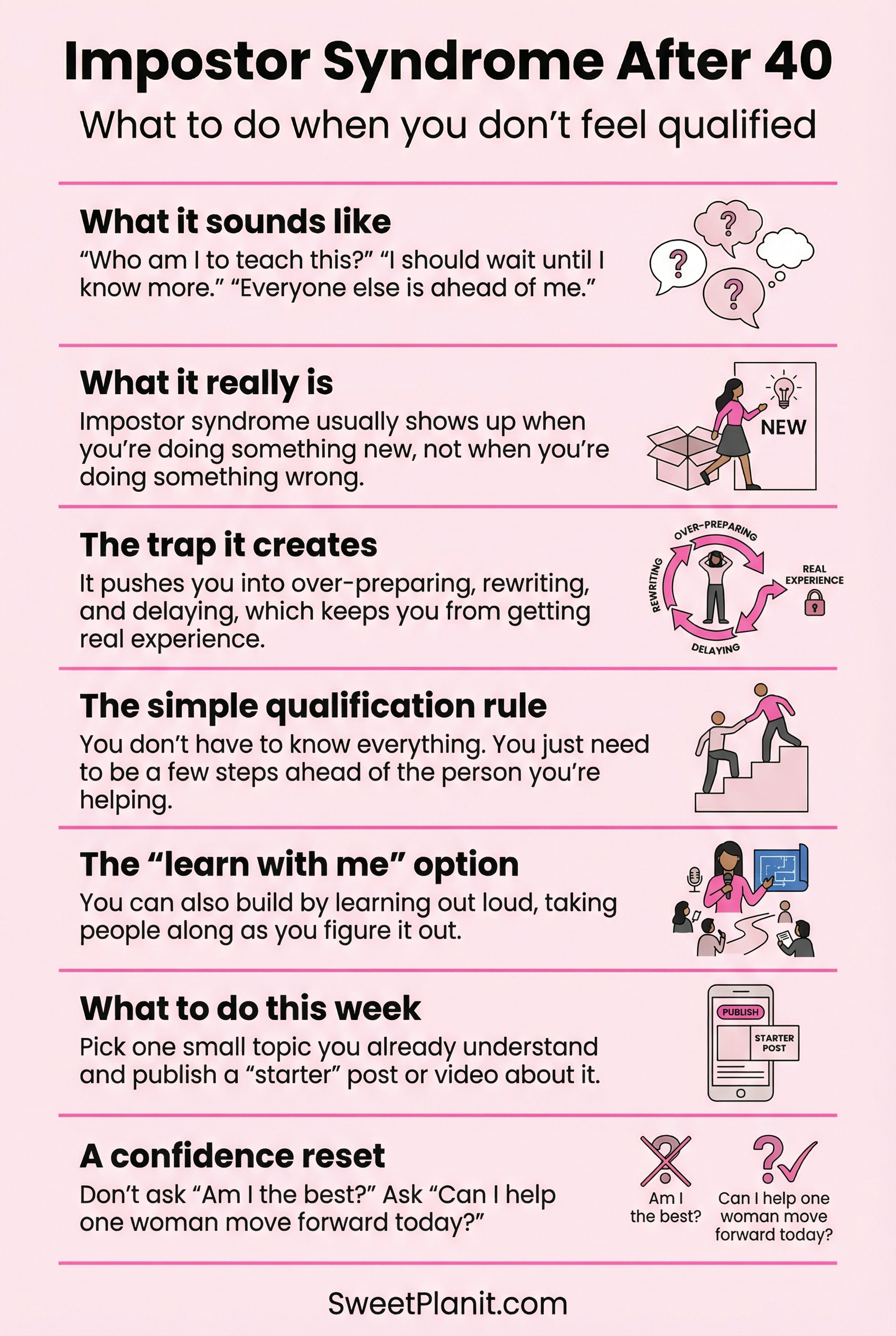
It rarely sounds dramatic. It sounds reasonable.
It sounds like:
“Who am I to teach this?”
“There are younger women doing this better.”
“I should wait until I know more.”
“I’m not techy enough.”
“I don’t look like the other creators.”
“Maybe I should just stay in my lane.”
It feels responsible. Careful. Thoughtful.
But underneath that, what’s really happening is this:
You are stepping into something unfamiliar.
And your brain’s job is to protect you from unfamiliar things.
That protection shows up as doubt.
The problem is, if you interpret that doubt as truth, you stop.
You procrastinate.
You over-prepare.
You rewrite the same paragraph twelve times.
You delay launching.
You keep researching instead of publishing.
I used to procrastinate when it showed up. I would stall instead of shipping, designing, or writing.
Now I recognize it for what it is: a signal that I’m growing.
And I move anyway. Even when I’m scared.
You Do Not Need to Be the Expert
This is where most women get stuck.
They think qualification means certification, mastery, or knowing everything there is to know.
It doesn’t.
You only need to be a few steps ahead of the person you’re helping.
If you’re teaching beginner website setup, you do not need to be a developer. You need to know more than the woman who is staring at a blank dashboard.
If you’re teaching YouTube basics, you do not need to have a million subscribers. You need to understand the first 100 videos better than someone who hasn’t posted yet.
There is also another option entirely.
You can build in public.
You can say, “I don’t know anything about sourdough bread, but I’m curious. Let’s learn together.”
That approach removes impostor syndrome almost immediately because you’re not claiming authority. You’re inviting growth.
If you love something but feel unqualified to teach it, try reframing your position.
Instead of:
“I am the expert.”
Try:
“I’m documenting what I’m learning and sharing what works (and doesn’t).”
That subtle shift changes everything.
When Doubt Shows Up, Do This
Instead of trying to eliminate impostor syndrome, learn how to respond to it.
Here is what I do now when that voice shows up:
1. Pause and inventory your experience.
When I questioned whether I could talk about websites and YouTube, I literally stopped and listed:
Almost 30 years of website ownership
Nearly 20 years on YouTube
Multiple pivots
Platform shifts survived
Revenue built across platforms
Seeing it on paper quieted the noise.
If you feel unqualified, write down your actual experience. Not your feelings. Your facts.
2. Define who you are helping.
You are not teaching the entire internet.
You are helping a specific woman who is just starting.
Ask yourself:
“Do I know more than she does about this?”
If the answer is yes, you can help her.
That is enough.
3. Hit Publish before you feel ready.
Impostor syndrome fades with evidence.
Evidence only comes from action.
Every post you publish.
Every video you upload.
Every comment you answer.
Those become receipts that you belong in the room.
If you wait to feel confident first, you will wait a very long time.
The Line Between Humility and Self-Sabotage
Healthy humility says:
“I don’t know everything, so I’ll keep learning.”
Self-sabotage says:
“I don’t know everything, so I shouldn’t start.”
The first keeps you growing.
The second keeps you invisible and holds you back from following your dreams.
You can be humble and still move forward.
You can say:
“This is what I’ve learned so far.”
“This is what worked for me.”
“This is where I messed up.”
That tone builds trust. It doesn’t diminish credibility.
Why This Hits Harder After 40
When you’re younger, you expect to be learning.
After 40, you feel like you should already know.
So when you step into something new —a new niche, a new platform, a pivot—the discomfort feels heavier.
But here’s what’s actually happening:
You have pattern recognition.
You have lived experience.
You’ve seen platforms rise and fall.
You’ve adapted before.
That is not a disadvantage. That is leverage.
When I remind myself that I’ve survived multiple platform shifts, algorithm changes, and business pivots, the doubt loses some power.
It doesn’t disappear.
It just gets quieter.
Does Impostor Syndrome Ever Go Away?
For me, it shows up every time I try something new.
It showed up when I started YouTube at 40.
It showed up when I wrote books.
It showed up when I pivoted Sweet Planit.
It showed up when I started speaking more boldly about business.
The difference now is that I recognize it faster.
Instead of thinking, “Maybe I shouldn’t do this,” I think, “Oh, this is that growth feeling again.”
Then I move anyway.
If You’re Feeling It Right Now
You are not broken.
You are not behind.
You are stretching.
And stretching always feels uncomfortable before it feels natural.
So here’s your next step:
Pick the smallest visible action.
Not a rebrand.
Not a full launch.
Not a perfect strategy.
One post.
One video.
One pillar.
One clear piece of content that helps someone else.
Then publish it.
Let the evidence accumulate.
Let the receipts build.
Impostor syndrome gets loud when you’re about to level up.
You don’t need to silence it.
You just need to keep moving.
You can do this!



If you’re building an online business after 40 and keep thinking, “Who am I to teach this?” — this post is for you. We’re talking about impostor syndrome in midlife, why it shows up when you try something new, and the practical steps to move forward anyway. Perfect for women starting a website, YouTube channel, or online business who need confidence and clarity to keep going.