
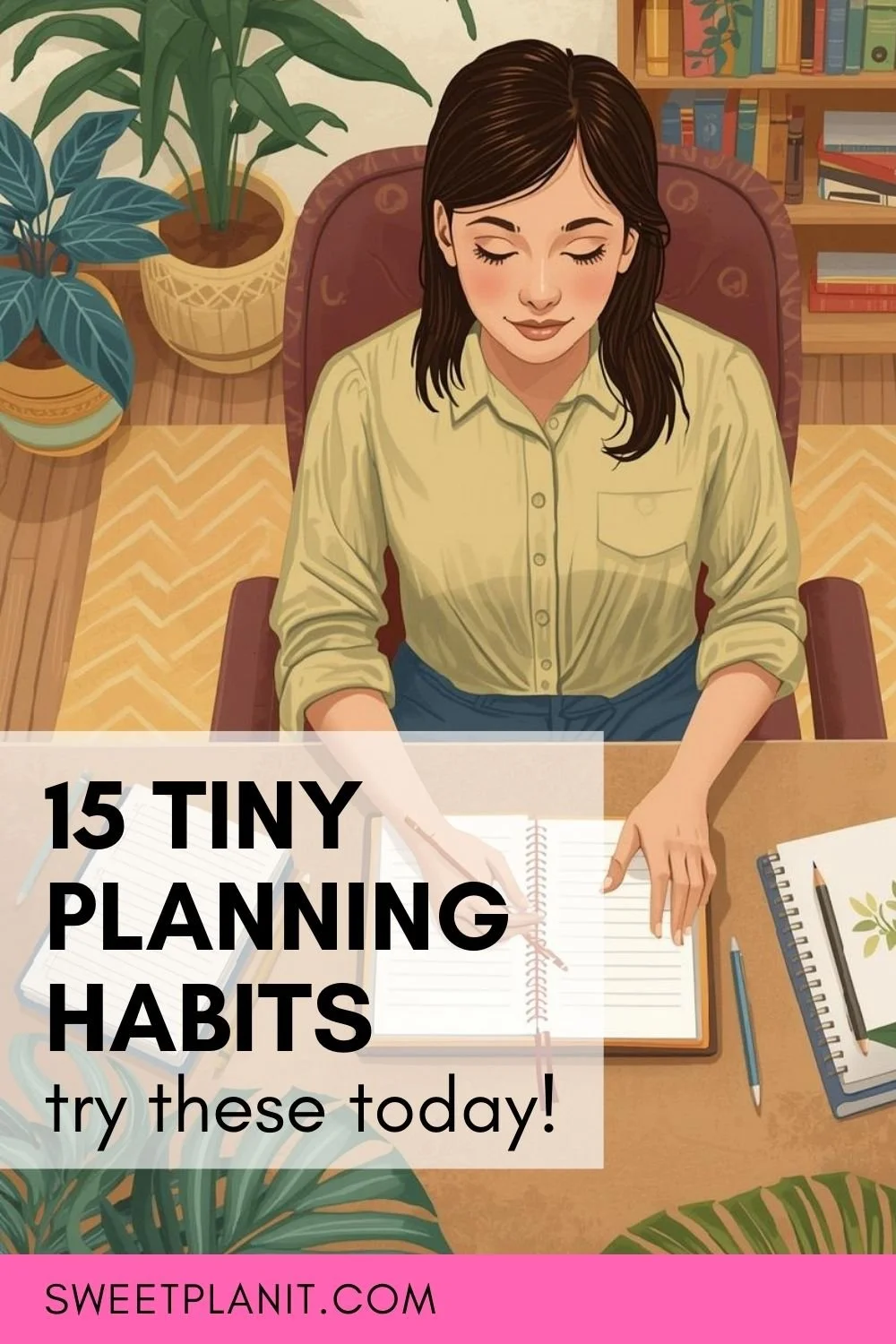
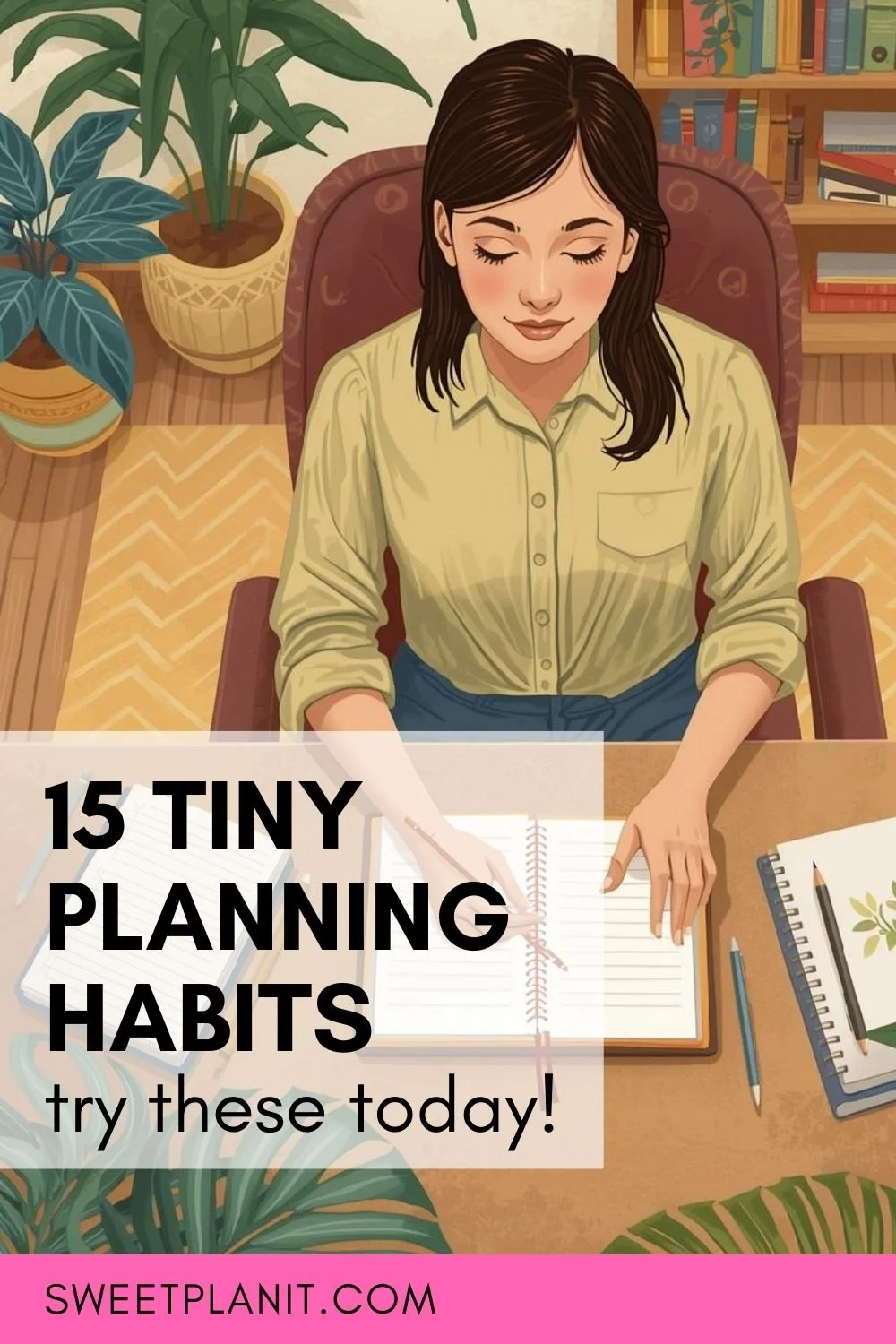
15 Tiny Planning Habits That Make Life Easier
You don’t need a new planner.
You don’t need better discipline.
You don’t need to “get it together.”
What you need are small planning habits that reduce mental load instead of adding to it.
These habits don’t look impressive. They feel relieving. And that’s the point.

1. Look at tomorrow before the day ends
Before you close your planner, your laptop, or your brain for the night, take 30 seconds to glance at tomorrow.
You’re not planning in detail. You’re just noticing:
What time the day starts
Any appointments or deadlines
One or two things that matter
This works because your brain hates uncertainty. When it knows what’s coming, it relaxes. When it doesn’t, it spins all night.
2. Choose a Top 3 instead of a giant to-do list
I love making a long brain dump of all the things I need to get done in the coming week. However, a long to-do list makes everything feel equally urgent, even when it isn’t.
So here’s what I started doing instead to make all of my to-do list achievable. I started using a daily Top 3.
A Top 3 forces clarity.
Ask yourself:
“If I only did these three things today, would the day still count as productive?”
Everything else becomes optional instead of overwhelming. That shift alone can change your entire mood.
Related Post: TOP 3
3. Write things down the moment you think of them
Every time you say “I’ll remember that,” you create an open loop your brain keeps revisiting.
Instead:
Write it in your planner
Add it to your notes app
Drop it on a master list
You’re not being forgetful. You’re freeing up mental space so you can focus on what you’re actually doing.
4. Reset one surface a day
If you look around your house and think, Why is this place always a mess, and why can’t I stay on top of it?
Here is an easy trick my husband taught me early on in our marriage: keep your most visible spot neat and tidy. Our dining room table was one of the first things you saw when you entered the condo, and was most often the first place we dumped everything when we walked in the door.
So we decided to keep that table clean and clutter-free at all times. The trick worked like a charm, and I’ve been doing it ever since to keep my home feeling tidy (even when other things might not be).
Pick one surface you see often:
Kitchen counter
Desk
Entry table
Bathroom counter
Clear it completely or almost completely.
One reset surface gives your eyes a place to rest, and that visual calm spreads faster than you expect.
5. Use the same planning time every week
When planning happens “whenever I get to it,” it usually doesn’t happen.
Choose:
Same day
Same general time
Same place
Your brain learns the rhythm and stops resisting. Planning becomes routine instead of something you have to convince yourself to do.
6. Stop rewriting the same unfinished tasks
If you’ve rewritten the same task three weeks in a row, it’s usually not a motivation problem.
It’s a clarity problem.
Most “sticky tasks” fall into one of these buckets:
It’s not on the calendar, so it never has a real home.
It’s too big, so your brain avoids starting.
It’s not actually a priority, but you feel guilty deleting it.
So instead of rewriting it again, do a quick decision check. Pick one of these four moves:
Move 1: Schedule it
If it truly matters, give it a time and place.
Example: “Call the dentist” becomes “Call the dentist Tuesday at 10:00.”
Move 2: Shrink it
If it’s too big, make the first step tiny.
Example: “Organize finances” becomes “Find the login” or “Print the last statement.”
Move 3: Delegate it
If someone else can do it, hand it off.
Example: “Book the oil change” becomes “Ask spouse/kid to schedule it” or “Use the online form and be done.”
Move 4: Park it or delete it
If it’s not urgent, move it to your “Later List.”
If it doesn’t matter anymore, cross it out without a speech.
Here’s the key: a task that keeps getting rewritten is usually asking for a decision, not more ink.
Rewriting feels productive, but it’s often just procrastination in neat handwriting.
Related Post: What to Do When Your To-Do List is Too Long
7. Plan for your energy, not your ambition
Ambitious plans feel exciting…until you’re tired.
Instead of asking:
“What do I want to do this week?”
Ask:
“What can I realistically repeat on a normal-energy day?”
Low-friction plans are the ones that stick.
8. Do a five-minute reset instead of waiting for “enough time”
Waiting for an hour feels responsible… and it’s also how nothing ever gets reset.
Because when life is busy, “I’ll do it when I have time” usually means “I’ll do it when I’m magically less tired,” and that day is not on the calendar.
A five-minute reset works because it’s small enough to repeat. It keeps little messes from turning into full-blown chaos, and it gives you that “okay, I’m back in control” feeling fast.
Here’s how to make this actually work:
Pick ONE reset, not five
Don’t try to cram your whole life into five minutes. Choose one tiny reset that gives you the biggest relief.
Use this quick menu and rotate as needed:
Surface Reset (5 minutes)
Clear one surface you’ll see again tomorrow: kitchen counter, desk, entry table.
This is the fastest way to make your space feel calmer.
Tomorrow Peek (2 minutes + done)
Look at your calendar and choose tomorrow’s Top 3.
You’re not planning the whole day. You’re just removing uncertainty.
Speed Tidy (5 minutes)
Set a timer and tidy one zone only: the entry, the coffee table, the bathroom counter.
Stop when the timer ends. The timer is the boss.
Mini Brain Dump (3 minutes)
Write down what’s swirling in your head, then circle the one thing you can handle first.
This clears mental clutter so you can think.
The rule that makes it stick
Five minutes is not the warm-up. Five minutes is the win.
If you do one tiny reset, you’ve already improved tomorrow.
Tiny resets are how you stay steady in real life, not with perfect schedules, but with repeatable habits.
If you’re feeling overwhelmed right now and don’t know where to start, I'll walk you through a simple reset here.
9. Keep one brain dump list (so your planner stays usable)
If you’re the type who has thoughts at random times, while driving, cooking, or trying to fall asleep, you don’t need a better memory.
You need one place to put the mental noise so it stops following you around.
That’s what a brain dump list is for.
It’s not your daily to-do list. It’s your “get it out of my head” list.
What goes on your brain dump list
Anything that’s clogging your brain, like:
errands and reminders
ideas you don’t want to lose
tasks that matter, but not today
“oh yeah, I need to…” thoughts
Where to keep it
Pick one place and commit to it:
one notes page in your planner
one running note on your phone
one sheet of paper on a clipboard
One place. Otherwise, it turns into three lists and a sticky note situation.
How to use it (this is the part people skip)
Once a day or once a week, scan your brain dump and do three quick moves:
Pull 1–3 items into your plan
These become your actual priorities, not the whole list.
Schedule anything time-sensitive
If it has a deadline, it goes on the calendar, not back into the pile.
Leave the rest alone
The brain dump is allowed to be messy. It’s a holding zone, not a performance.
The win here is simple: your daily plan stays focused, and your brain stops trying to remember everything at once.
10. Look at your week before it starts (so you don’t get blindsided)
Once a week, take five minutes to look ahead at the next 7 days.
Not to plan every detail. Just to see what you’re walking into.
Because the week doesn’t feel overwhelming when it’s on paper. It feels overwhelming when it surprises you on Tuesday.
Step 1: Do a fast calendar scan
Look for:
appointments, meetings, school stuff
deadlines or “fixed” commitments
anything that requires extra time (driving, prep, follow-up)
Circle the days that are already heavy. Those are your “don’t overload this day” days.
Step 2: Spot your pinch points
Ask:
Which day is the most packed?
Which day has the least flexibility?
Which day will I likely be tired?
These aren’t problems. They’re warnings. And warnings are helpful.
Step 3: Make three tiny adjustments (this is the magic)
Pick just 1–3 small moves that make the week smoother:
Move one task off a heavy day
If Tuesday is stacked, stop pretending you’ll also deep clean the pantry. Shift it.
Add a mini reset to the hardest day
Even five minutes. A Top 3 check-in, a quick tidy, a brain dump. Something that keeps you steady.
Choose one “anchor” habit for the week
One repeatable thing you’ll do most days, like: Top 3, 10-minute reset, short walk, early bedtime. This gives the week structure.
Why this works
When you look ahead, you stop planning like the week is empty.
You plan like your life is real.
And that’s how planning starts to feel supportive instead of stressful.
This habit is part of my weekly reset. If you want the full routine, start here.
11. Decide what “done” looks like (so tasks stop dragging on forever)
A lot of planning stress comes from vague tasks.
“Work on finances.”
“Clean the house.”
“Get organized.”
“Plan content.”
Those aren’t tasks. They’re categories. And categories never feel finished, which is why they drain you.
Instead, decide what “done” means before you start.
The easiest way to do this
Turn every vague task into a finish line you can actually cross.
Ask:
“What does done look like in one sentence?”
Then write the task as:
Verb + specific outcome, Examples:
“Email the doctor to schedule the appointment.”
“Pay the electric bill online.”
“Put laundry in the dryer and fold one load.”
“Clear the kitchen counter and wipe it down.”
“Outline the blog post, write the intro, hit save.”
“Pick Top 3 and set tomorrow’s first step.”
When “done” feels too big, choose the minimum done
Some days you don’t need the full version. You need the minimum version.
Example:
Instead of “Clean the house” → “Reset the kitchen and start one load of laundry.”
That’s enough to feel better and keep momentum.
Why this works
When “done” is unclear, your brain keeps the task open like a tab that never closes.
You overthink it, procrastinate, or keep “working on it” without finishing.
When “done” is defined, you can complete it, check it off, and move on with your life.
And honestly, that’s the whole point.
12. Leave white space on purpose (so your week doesn’t fall apart)
A packed schedule looks productive…until real life shows up.
A late appointment. A phone call that runs long. A kid needs something. You’re tired. Traffic happens. Your brain decides to quit at 2:00 p.m.
If your week has zero breathing room, one small disruption can collapse the whole plan. That’s why white space isn’t extra. It’s what makes the plan work.
What white space actually is
White space is not “doing nothing all day.”
It’s simply unscheduled buffer time that gives your life somewhere to land.
Think of it like shock absorbers for your schedule.
How to build white space without overhauling your life
Pick one of these simple strategies:
Leave one block blank every day
Even 30 minutes.
Don’t assign it ahead of time. It’s there for spillover, errands, or a quick reset.
Use the “two-thirds rule” for your day
Only plan about two-thirds of what you think you can do.
That last third is where interruptions go, and you’ll still finish feeling successful.
Protect one lighter day per week
If you can, choose one day where you don’t stack appointments and heavy tasks.
This becomes your catch-up day or your recovery day, depending on the week.
Add travel and transition time
If something starts at 2:00, that doesn’t mean you’re free until 1:59.
Give yourself 10–15 minutes to transition, or you’ll feel behind all day.
Why this works
White space keeps you from needing to “start over” every time life interrupts.
It protects your energy and your mood, which is the real reason you can stay consistent.
Empty space isn’t laziness. It’s what keeps your plan realistic and actually doable.
13. Use one planner system for everything (so you stop losing your own life)
Splitting life across multiple planners feels organized… until you can’t find anything.
One calendar here. A notebook there. A sticky note on the counter. A notes app list you forget exists. Then you spend more time tracking your tracking than actually doing the thing.
That’s the friction.
The goal isn’t to be “minimal.” The goal is to have one home base so your brain can relax.
What “one system” really means
It doesn’t mean you can’t use other tools.
It means you choose one place that’s the source of truth.
The place you check first. The place you trust.
The simplest way to set it up
Your main system should hold four things:
Appointments (calendar commitments)
If it has a time, it goes here. Always.
Tasks (what needs to happen)
This is your Top 3 + whatever else fits, not a 47-item guilt list.
Notes (what you don’t want to forget)
Meeting notes, phone call notes, quick reminders.
Ideas (brain dump space)
A running list where ideas can live without taking over your day.
If you love multiple notebooks, here’s the rule
You can absolutely keep a separate notebook for journaling, creativity, or random thoughts.
Just don’t let those notebooks become decision-makers.
The rule is:
If it affects your schedule or your priorities, it gets moved into your main system.
That way, you can still enjoy notebooks without losing track of what matters.
Why this works
Every extra “place” you store life creates:
more searching
more forgetting
more mental load
One system gives you less friction, less stress, and more follow-through, because you’re not constantly trying to remember where you put your own plans.
14. Reset before you feel behind (this is how you avoid the “start over” spiral)
Most people wait too long.
They don’t reset when things are a little off. They wait until everything feels like a mess… and then they think they need a full restart, a new week, or a new planner.
But the best resets happen early, when the problem is still small.
What “slightly off” actually looks like
This is your cue to reset:
you keep thinking, “I’m forgetting something”
your to-do list is growing but nothing is moving
your counters/desk are starting to collect piles
you’re avoiding your planner because it feels heavy
you’re behind on one or two small things and it’s starting to bug you
That’s not failure. That’s simply your signal: time for a mini reset.
The 5-minute “catch it early” reset
When you feel that little wobble, do this:
Brain dump for one minute
Get the mental noise out on paper.
Choose a Top 3 for the next 24 hours
Not ten things. Three. The ones that will relieve pressure.
Reset one surface
One spot that your eyes keep landing on. Clear it fast.
Make one decision about one nagging task
Schedule it, shrink it, delegate it, or move it to later.
That’s it. You just pulled yourself back on track before things snowballed.
Why this works
Resets aren’t for when everything is broken.
Resets are for when you want to stay steady.
A small check-in at the right time prevents that dramatic “I need to start over” feeling and keeps momentum intact, even in real life.
15. Show up again after you fall off (this is the real consistency skill)
Missing a day isn’t the problem.
The problem is what happens next.
Most people miss a day and immediately start telling themselves a story:
“I’m behind.”
“I ruined it.”
“I’ll start Monday.”
“I guess I’m not consistent.”
And that story is what turns one missed day into a full stop.
Here’s the rule
A miss is normal. Life is life.
What matters is how fast you return.
Because the faster you come back, the smaller the “fall off” becomes.
What to do the day you restart
Don’t try to catch up. Don’t “fix everything.” That’s how you quit again.
Do the smallest restart that gets you moving:
Open your planner and write today’s date
This is the re-entry point. No guilt review. Just today.
Do a one-minute brain dump
Get the mental clutter out so you can think clearly.
Pick a Top 3 (and make one of them tiny)
Not “clean the house.”
More like: “pay the bill, email the teacher, reset the counter.”
Do one reset in five minutes
One surface. One small area. One quick win.
That’s it. You’re back.
If consistency has been the hard part for you, this post will help you reset without quitting.
Why this works
Restarting isn’t a personality trait. It’s a skill.
And every time you come back without a shame spiral, you train your brain to trust that you don’t quit just because life gets messy.
That’s what real consistency looks like.
The real takeaway
Planning isn’t about doing more.
It’s about creating less friction between you and the life you’re already living.
Tiny habits work because they’re gentle, repeatable, and realistic.
Pick one. Try it this week.
That’s how planning starts to feel lighter.
Happy planning!




Working from home sounds like freedom, until you can’t focus and your to-do list just stares at you. This simple Sweet Planit routine helps you reset your brain, choose a clear Top 3, time block your day, and actually get work done without overplanning. Practical, doable, and made for busy seasons.