
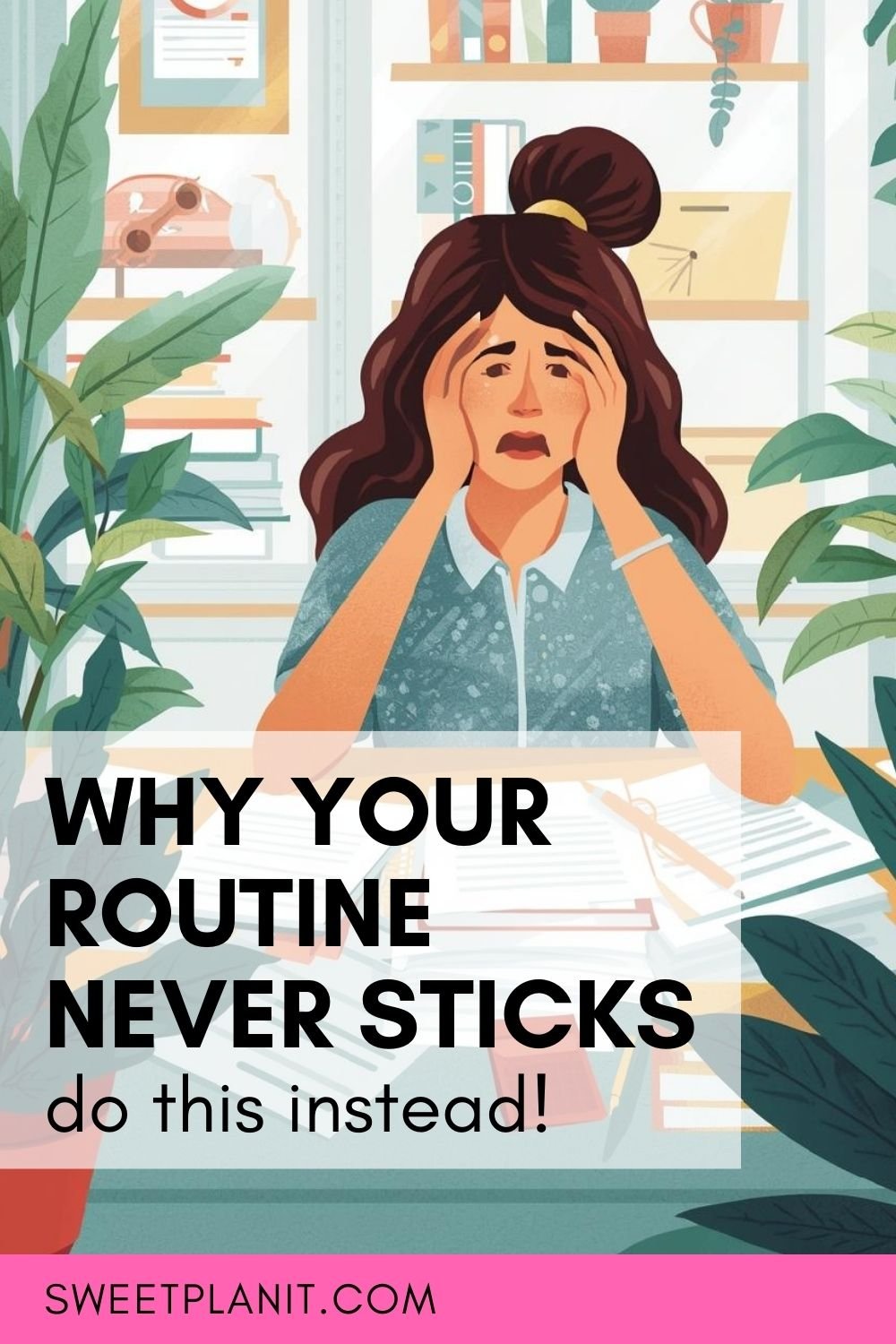
Why Your Routine Never Sticks (And It’s Not Your Fault)
If copying someone else’s routine actually worked, you’d be thriving by now.
You’ve tried the morning routine.
The night routine.
The color-coded planner system.
The “do this before 6 a.m.” checklist from someone who apparently has a completely different nervous system.
And yet…here you are. Still feeling behind. Still restarting. Still wondering what you’re doing wrong.
Here’s the truth most productivity advice skips:
You’re not failing the routine.
The routine was never designed for you.
Let’s talk about why copying other people’s routines keeps backfiring, and what to do instead if you want something that actually sticks.

The Routine Trap No One Talks About
Most routines you see online are created for one of three reasons:
They worked for that person, in that season of life.
They look impressive on camera.
They sound good when written out.
None of those means they’ll work in your real life.
What you’re usually copying isn’t just a routine. You’re copying:
Someone else’s energy level
Someone else’s schedule
Someone else’s responsibilities
Someone else’s tolerance for structure
Someone else’s current season
And then you’re surprised when it collapses by day four.
That’s not a discipline problem. That’s a design problem.
Why “Successful People’s Routines” Are So Misleading
We love routines because they promise certainty.
“If I just do what she does, I’ll get the same results.”
But here’s what rarely gets mentioned:
Most people share routines after they’ve already built momentum, not while they were building it.
They’re showing you:
Their optimized system
Their polished version
Their after-the-fact clarity
Not the messy, inconsistent process it took to get there.
Trying to adopt that routine wholesale is like putting on someone else’s prescription glasses and wondering why you’re dizzy.
The Hidden Reason Routines Fall Apart: Cognitive Load
This is the part almost no one explains.
A routine fails when it adds more thinking, not less.
If your routine requires you to:
Remember, too many steps
Make decisions when you’re already tired
Switch between multiple systems
Be “on” all day long
It’s not supporting you. It’s draining you.
And the more overloaded you already feel, the faster that routine will collapse.
That’s why copying someone else’s system often makes you feel worse, not better. It increases cognitive load instead of reducing it.
Related Post: What to Do When You’re Feeling Overwhelmed
The Difference Between a Routine and a Rhythm
This is where things shift.
A routine is rigid.
A rhythm is responsive.
Routines say:
“Do this every day, exactly like this.”
Rhythms say:
“This is the order things tend to work best for me.”
Rhythms allow for:
Low-energy days
Busy seasons
Life interruptions
Human inconsistency
When you copy someone else’s routine, you’re borrowing structure without context.
What you actually need is your own rhythm.
Related Post: The Sunday Reset That Makes Mondays Easier
Why Your Routine Keeps “Working for a Week” and Then Disappearing
If you’ve ever thought, “This worked for a few days and then I fell off,” here’s why.
Most borrowed routines are built around:
Ideal mornings
Perfect evenings
Unlimited focus
Zero interruptions
They don’t account for:
Bad sleep
Unexpected appointments
Decision fatigue
Emotional load
So when real life shows up, the routine doesn’t bend. It breaks.
And instead of adjusting the system, you assume you are the problem.
You’re not.
What Actually Works: Designing From the Inside Out
Instead of asking:
“What routine should I copy?”
Try asking:
“What do I need support with right now?”
That might be:
Starting the day without chaos
Remembering fewer things
Making decisions ahead of time
Resetting when things feel off
Staying consistent without pressure
From there, build small, supportive anchors, not full routines.
Examples:
A 5-minute night-before reset
A simple Top 3 each morning
One weekly reset touchpoint
One surface you always reset
One habit you protect, no matter what
These are pieces you can repeat even when life is loud.
Related Post: What to Do When Your To-Do List is Too Long
Why “Personalized Routines” Still Miss the Point
Even when advice says “customize it,” it often still assumes you want:
More structure
More steps
More optimization
But many women don’t need more systems.
They need:
Less friction
Fewer decisions
Clear stopping points
Permission to simplify
A routine should relieve pressure, not add it.
If your system requires constant motivation to maintain, it’s not the right system.
The Real Goal Isn’t Consistency. It’s Recovery.
This is the mindset shift that changes everything.
People who “stick with routines” aren’t more disciplined.
They’re better at:
Restarting quickly
Adjusting without drama
Returning without guilt
They don’t cling to a routine that no longer fits. They let it evolve.
That’s why copying someone else’s routine keeps failing you. You’re trying to be consistent with something that was never aligned in the first place.
Related Post: How to Stay Consistent When Life Gets Messy
What to Do Instead (Starting This Week)
If you want something that actually works, try this approach:
Pick one reset, not a full routine
A weekly reset. A nightly reset. One anchor point.
Decide what it’s allowed to look like on a bad day
This keeps it repeatable.
Remove steps until it feels almost too simple
That’s where consistency lives.
Let it change with the season
Busy seasons need lighter systems.
You don’t need someone else’s routine.
You need a system that respects your energy, your life, and your capacity right now.
That’s how planning stops feeling like a performance and starts feeling like support.
Happy planning!



Working from home sounds like freedom, until you can’t focus and your to-do list just stares at you. This simple Sweet Planit routine helps you reset your brain, choose a clear Top 3, time block your day, and actually get work done without overplanning. Practical, doable, and made for busy seasons.