
How to Choose Your First 30 Posts (So Your Website Doesn’t Feel Random)
One of the biggest reasons websites feel scattered isn’t design.
It’s content without structure.
You sit down to write and think,
“What should I post this week?”
And because there’s no bigger plan, you pick whatever feels interesting that day.
After ten posts, the site feels mixed.
After twenty, it feels unfocused.
After thirty, you’re tired…and still not sure what you’re building.
Let’s fix that before you waste months.
I’m going to show you exactly how I choose the first 30 posts for a new website and why that structure matters more than search, monetization, or aesthetics in the beginning.

Step 1: Make Sure You Can Actually Talk About This
Before I write a single post, I ask myself one uncomfortable question:
Do I actually want to talk about this topic a lot?
Not just enjoy it.
Not just be interested in it.
But talk about it over and over again.
Because here’s the truth: just because something is a hobby doesn’t mean you want to build a business around it.
If you’re going to write 30 posts, and then 60, and then 100, you need depth. You need layers. You need more than surface-level enthusiasm.
So in my first week, I do this:
I sit with the idea.
I think about my skills and experience.
I ask myself, “Can I go deep here? Do I have something useful to add?”
If the answer is yes, then I move forward.
Step 2: Research Like an Adult, Not Like a Trend Chaser
Once I’m confident in the niche, I research.
Not obsessively. Not to compete.
Just to understand the landscape.
I go to:
Google
ChatGPT
Pinterest
Other websites in the same niche
And I look at what people are actually asking.
If I see a lot of content on a topic, that doesn’t scare me.
It tells me there’s demand.
Competition is not a red flag.
It’s validation that there is an audience for what you want to write about.
If no one is talking about something, that’s not a hidden gem. That’s usually a sign there isn’t much interest.
While I’m researching, I create a long, messy list of ideas. Seventy-five to one hundred ideas. No filtering yet.
I want to see if this niche can actually sustain content.
If I struggle to get to 40 ideas, that’s a signal.
If I easily get to 100, I know I’m in the right place.
Step 3: Turn That Mess Into 3 Pillars
Once I have my long list, I do something very important:
I sort every idea into categories.
This is where your website stops feeling like a hot mess and starts feeling like a brand.
Let me give you a simple example.
If I were building a website about lemons (stay with me),
My pillars might look like this:
Growing and Caring for Lemon Trees
Types and Uses of Lemons
Lemon Recipes
Now every post idea must fit into one of those three.
If it doesn’t fit, it doesn’t belong.
That’s containment.
And here’s something interesting: sometimes while organizing, I realize my pillars need adjusting.
Maybe I see that recipes need to be split into sweet and savory.
Maybe I notice I’m missing a pillar entirely, like:
Lemon Uses for Health and Cleaning
That refinement only happens when you actually map things out.
You don’t discover your structure by thinking about it forever.
You discover it by organizing real ideas and writing about them.
Step 4: Commit to 10 Posts Per Pillar
If you have 3 pillars, your first 30 posts are simple:
10 posts per pillar.
That’s it.
At this stage, I don’t worry about:
Monetization
Affiliate strategy
Search optimization
Length requirements
Viral potential
This is foundation-building.
You’re creating the basic library that tells your reader, “She knows what she’s talking about.”
These posts should be:
Beginner-friendly
Focused
Clear
Helpful
Think, “If someone new landed here, would this guide them well?”
Not “Will this rank?”
Step 5: Interlink Like You Mean It
One of the biggest things I learned over 20+ years is this:
Your posts should talk to each other.
If someone is reading about caring for a lemon tree, and you have a post about the best soil for citrus plants, link it.
If she’s reading about lemon recipes and you’ve written about preserving lemons, link it.
That relationship between posts builds authority and trust.
And trust is what makes monetization possible later.
A lot of new website owners try to monetize too early.
But you can’t monetize someone who doesn’t trust you yet.
First, build depth.
Then layer in:
Email capture
Affiliate links
Digital products
Ads
Foundation first.
Revenue second.
What Makes a Post Worth Writing?
After all these years, here’s my internal filter.
When I see an idea and think, “Yes, that’s worth writing,” it’s usually because:
I know she’s struggling with it right now.
That’s it.
Not because it’s trending.
Not because it’s 1,500 words.
Not because a keyword tool told me to.
But because I can clearly picture the woman reading it, and I know how to help her.
That clarity matters more than optimization.
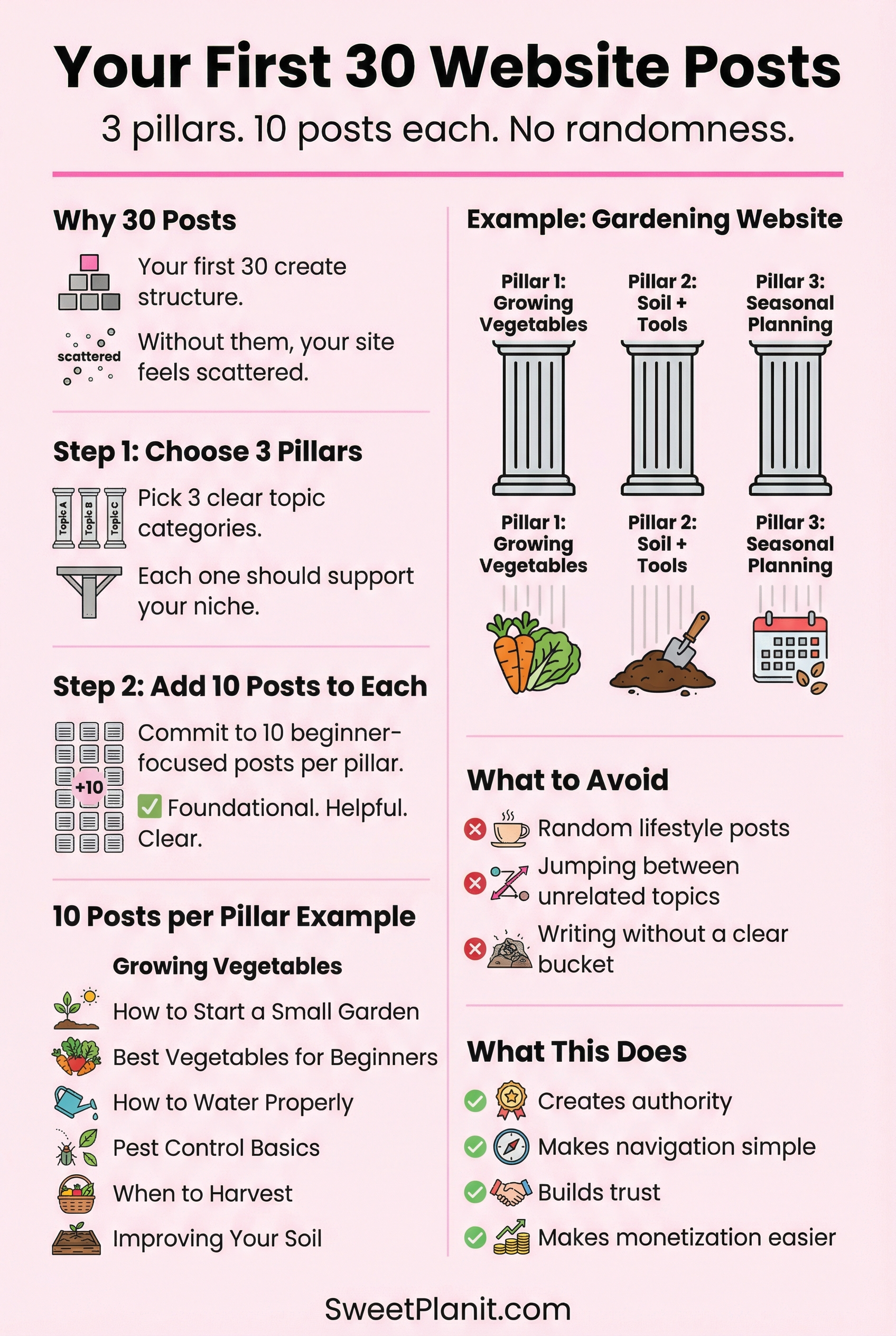
Real Example: What This Looks Like in Practice
Let’s say someone is starting a gardening website.
Her three pillars might be:
Beginner Gardening Basics
Seasonal Planting Guides
Garden Problem Solving
Her first 30 could look like:
Beginner Basics:
How to Start a Garden in a Small Yard
Essential Tools for New Gardeners
How to Prep Soil the Right Way
Raised Beds vs. In-Ground
How Often to Water
What to Plant First
Beginner Gardening Mistakes
Composting for Beginners
Understanding Sun Exposure
Planning Your First Layout
Seasonal Guides:
What to Plant in Spring
What to Plant in Summer
Fall Garden Prep
Winter Garden Maintenance
Starting Seeds Indoors
Direct Sowing vs. Transplanting
Seasonal Fertilizing Schedule
Companion Planting Basics
Rotating Crops
How to Extend Your Growing Season
Problem Solving:
Why Are My Leaves Turning Yellow?
Dealing With Pests Naturally
Preventing Overwatering
Fixing Poor Drainage
Identifying Plant Diseases
How to Revive Dying Plants
Dealing With Weeds
Managing Shade
Fixing Nutrient Deficiencies
Protecting Plants From Heat
That is not random.
That is structured.
After 30 posts, that site feels intentional.
And here’s the part people don’t expect:
You might discover something during those 30.
Maybe you love the problem-solving posts more.
Maybe they get more traction.
Maybe you realize your audience cares most about seasonal planning.
That’s when refinement happens.
That’s how I realized Sweet Planit needed to pivot.
Not because I lacked a niche.
But because writing deeply revealed what I actually wanted to build.
You don’t discover direction by waiting.
You discover it by writing.
If You’re Overwhelmed Right Now
Do this:
Choose your niche.
Brain dump 75–100 ideas.
Sort them into 3 pillars.
Commit to 10 posts per pillar.
Write them before redesigning your website.
Do not:
Redesign your logo
Tweak fonts
Rebuild navigation repeatedly
Rewrite your About page 12 times
Write weekly life updates
Right now, no one is watching.
That’s not discouraging. It’s freeing.
You are building the bones.
Once you have 30 focused posts, your direction becomes obvious.
And when your direction is obvious, your website stops feeling random.
It starts feeling like a brand.
And that’s when real growth can begin.
You can do this.







Thinking about starting a website in 2026 but wondering if AI and social media have made blogs irrelevant? This post breaks down what’s actually changed, why platforms like Instagram and Facebook are rented space, and when building your own website still makes strategic sense. If you’re a woman over 40 building an online business and want something you control, not just followers you borrow, this will help you decide your next move with clarity.