
How to Talk on Camera When You Feel Awkward
Let’s just say this first.
Talking to a camera in a room by yourself is weird.
It just is.
You’re standing there, staring into a lens, trying to sound natural, hoping your voice doesn’t do something strange, wondering what your hands are doing, and thinking, “Is this how I actually look?”
You are not broken if this feels uncomfortable.
It’s unfamiliar.
And unfamiliar things feel awkward until they don’t.
I’ve been on camera for almost 20 years now. I’ve filmed for YouTube. I’ve gone live on QVC. I’ve recorded tutorials, list videos, sponsored integrations, short-form, and long-form, all of it.
And I’ll tell you something honest:
The first few seconds of filming still feel awkward.
Then I start talking, and it goes away.
So let’s talk about what’s really happening and what to do about it.
First: Awkward Isn’t a Sign You Should Quit
Most women think awkward means:
“I’m not cut out for this.”
No.
Awkward means you’re doing something new.
When I started my YouTube channel at 40, I had no roadmap. I had intention, but no skill. My angles were off. My thumbnails were rough. Editing took forever. I’d mess up a sentence four or five times and think, Nancy, really?
But you build comfort by repetition, not by thinking.
There is no way around the “awkward phase.” The only way through it is through it.
Even now, when I hit record, there’s a split second of stage jitters. It’s like walking out on stage before a crowd.
Then you start.
And your brain shifts.
The Real Reason You Feel Awkward
You’re focused on yourself.
Your face.
Your voice.
Your wrinkles.
Your posture.
Your background.
That’s normal. We’re not used to seeing ourselves the way others see us.
But here’s the shift that changes everything:
YouTube isn’t about you.
It’s about the woman watching.
The moment you move from:
“How do I look?”
to
“Is this helpful?”
The awkwardness drops by at least half.
When I have friends who say, “I hate my face on camera” or “I sound weird,” I tell them the same thing:
You’re making this about the wrong person.
If you’re helping someone solve a problem, learn something new, or feel understood, she is not sitting there critiquing your crow’s feet.
She’s grateful.
Your job is not to look perfect.
Your job is to be useful.
Energy Is Everything (And the Camera Steals 20%)
Here’s something no one tells you:
The camera flattens your energy.
At least 20%. Maybe more.
If you feel calm and steady in real life, you might look tired on camera.
So before I hit record, I check my energy.
If I feel low, I literally hype myself up. I’ll do an exaggerated fake laugh, which makes me actually laugh, and then I immediately hit record.
It shifts my tone. My eyes brighten. My voice lifts.
I feel and sound like I’m ready for fun, and I’m bringing her on the journey with me.
You don’t need to become someone else.
You just need to bring 20% more than you think you need.
Keep the Camera Rolling
This one is practical.
I never stop and restart the camera every time I mess up.
I keep it rolling the entire time.
If I flub a sentence, I just pause and say it again.
That does two things:
It keeps your rhythm.
It removes the pressure of “I have to get this perfect.”
Editing fixes mistakes.
You don’t need to be flawless in real time.
Related Post: If I Had to Start My YouTube Channel Over at 40
Stop Waiting for the Perfect Setup
I own a very expensive digital camera.
Guess what I use 90% of the time?
My iPhone.
Because it’s with me. It’s easy. I can turn it on and film in seconds.
My favorite mic? A $13 Amazon mic.
My lights? Basic umbrella lights.
My tripod? A combo selfie-stick/tripod.
When my setup was complicated, I avoided filming.
When it became simple, I filmed more.
Awkwardness increases when the process feels heavy.
Make it easy to start.
Look at the Lens Like It’s a Person
If you’re staring at yourself in the preview screen, you’ll feel stiff.
Look at the lens.
Not in a creepy, frozen way.
Look at it like you would look at someone in conversation. Eye contact, glance away, back again.
Some creators tape a photo of their ideal viewer next to the camera. That helps too.
You’re not talking to a machine.
You’re talking to one person.
Related Post: 90-Day Plan to Launch Your YouTube Channel
Yes, You Will Cringe at Old Videos
I go back and watch some of my early content and think:
Oh wow.
But here’s the truth.
You were doing the best you could with what you knew at the time.
Skill only develops through doing.
Even Mr. Beast says your first 100 videos won’t be great.
Make them anyway.
Not recklessly. Not carelessly.
But consistently.
You cannot skip the learning phase.
The Impostor Syndrome Doesn’t Fully Leave
You might be surprised to hear this.
Even after almost 20 years on YouTube, I still sometimes think:
Am I qualified to talk about this?
That voice doesn’t disappear.
You just get better at ignoring it.
Push past it.
Hit record anyway.
A Quick Reset When You Feel Weird
If you’re about to film and feel awkward, try this:
Check your energy — lift it slightly.
Shift your focus to the viewer.
Keep the camera rolling.
Speak one sentence at a time.
Remember, this is a skill, not a personality trait.
And if you need structure, use an outline instead of a full script.
Glance at your notes.
Look at the camera.
Speak naturally.
No teleprompter monotone required.
Now, Try my 7-Day Get Comfortable On Camera Plan
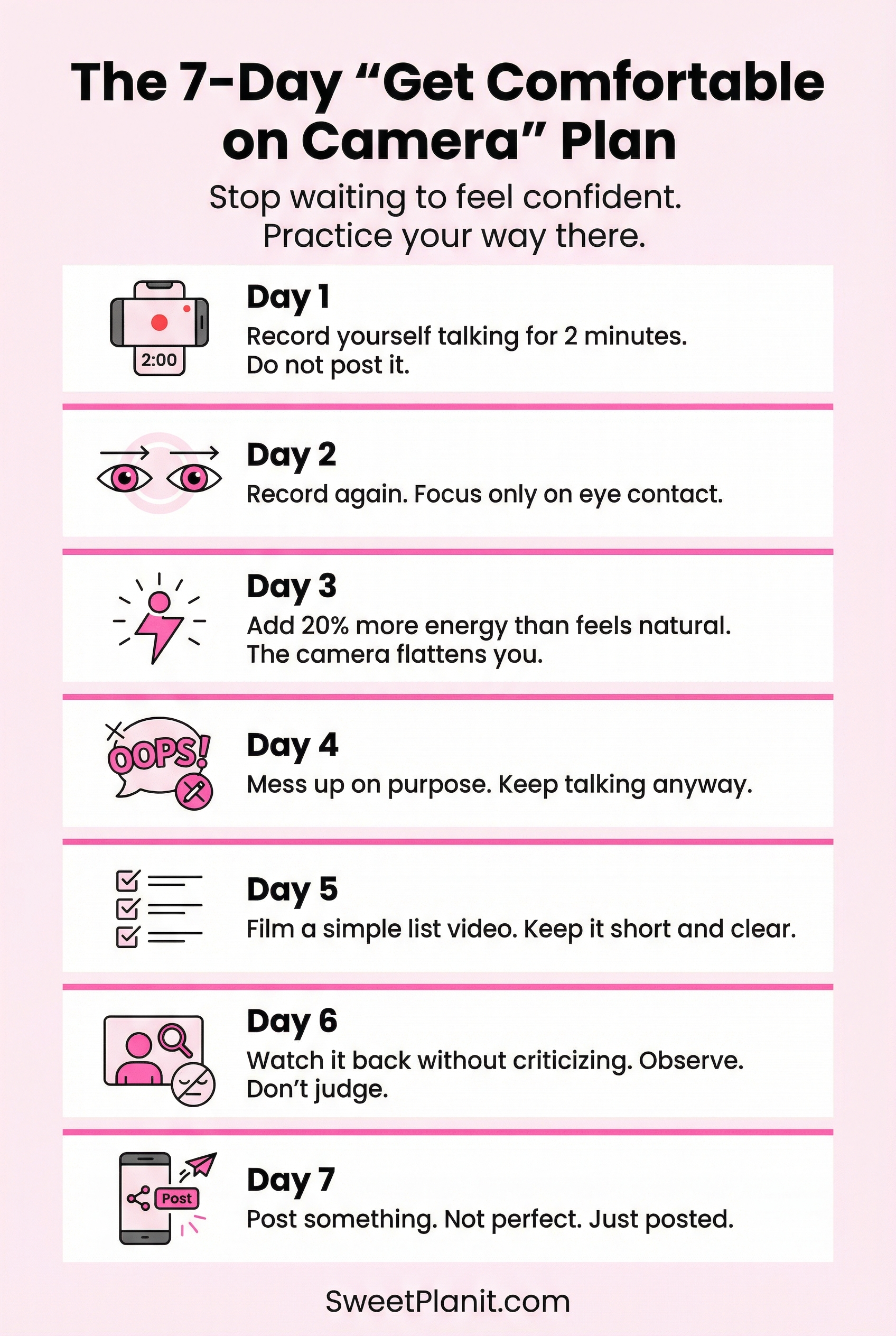
The 7-Day “Get Comfortable on Camera” Plan
If you want something structured, here’s a simple progression:
Day 1: Record yourself talking for 2 minutes. Don’t post it.
Day 2: Record again. Focus only on eye contact.
Day 3: Practice adding 20% more energy.
Day 4: Mess up on purpose and keep going.
Day 5: Film a short, simple list video.
Day 6: Watch it back without criticizing.
Day 7: Post something. Not perfect. Posted.
Because confidence comes from action, not rehearsal.
You will probably always feel a tiny flicker of awkwardness when you start.
That’s normal.
What changes is this:
You stop letting it stop you.
You focus on the woman watching.
You simplify your setup.
You keep going.
And one day, you’ll look at yourself on camera and think:
Okay.
I’m actually fine.
You can do this!


Overwhelmed by YouTube gear? Here’s the simplest YouTube setup that still looks professional, without buying an expensive camera or building a studio. In this post I walk you through what actually matters (especially audio), the beginner-friendly lighting + framing setup, and the exact low-friction gear I use to film fast and consistently. Perfect if you’re starting YouTube over 40, filming at home, and want a simple creator setup that feels polished and approachable.