
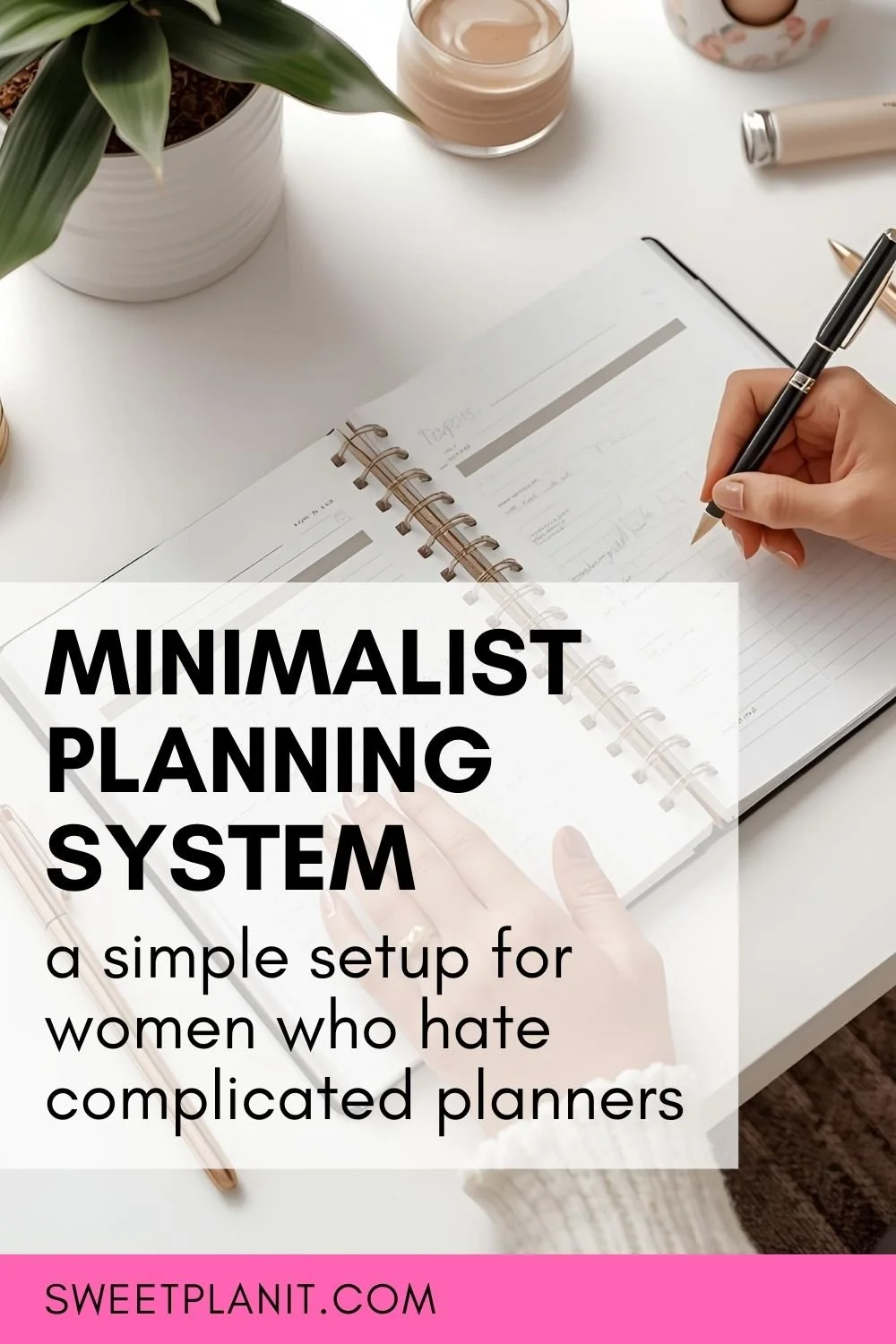
The Minimalist Planning System for Women Who Hate Complicated Setups
If you’ve ever opened a new planner full of blank pages and thought, “This is cute and also… absolutely not happening,” welcome. You are my people.
Because planning should not feel like a second job. It should feel like a small, steady support system that makes life easier, not louder.
This minimalist planning system is for the woman who wants to feel organized again, but does not want to color-code her way into a nervous breakdown. You want simple. You want realistic. You want a setup that takes minutes, not a whole Sunday afternoon and a trip to Michaels.
Let me show you the SweetPlanIt way to plan less and live more.

What minimalist planning actually means
Minimal planning is not “doing nothing” and hoping your life sorts itself out.
It means:
you plan only what matters
you keep it visible and simple
you stop trying to manage your entire existence down to the minute
Minimal planning is clarity without clutter.
You still have goals. You still have responsibilities. You just stop treating your planner like it has to hold your whole personality.
Why complicated planning doesn’t work for real life
Complicated systems feel exciting for about ten minutes. Then real life shows up.
You miss a day.
You get behind.
Your planner looks messy.
You feel guilty.
You quit.
Not because you are lazy. Because the system was built for a fantasy schedule.
Minimal planning works because it leaves room for:
your energy levels
surprise appointments
family needs
days that go off the rails
being a human
A good system supports real life, not the version of you who never gets tired.
The minimalist planning system (simple, repeatable, realistic)
Step 1. Pick your planner home base (2 minutes)
Paper or digital, doesn’t matter. Pick the one place your life lives.
One planner.
One system.
One home.
If you spread your brain across three planners and four apps, you will feel scattered, not organized.
So choose your main planner and commit to it for this season of life.
Step 2. Do a weekly reset (10 to 15 minutes, once a week)
This is the core of the whole system.
Once a week, you sit down and answer:
What’s coming up this week?
What matters most this week?
What do I need to prepare for?
That’s it.
Your weekly reset keeps you from waking up on Wednesday feeling like you missed a memo.
If you want the full step-by-step, read A Simple Weekly Reset That Keeps You On Track. This minimalist system plugs into that perfectly.
Step 3. Choose your weekly Top 3 (3 minutes)
Every week, you pick three priorities.
Not nine. Not twelve. Three.
These are the things that would make you say, “Okay, that was a solid week.”
They can be:
personal
home
business
health
family
a goal step
If your list is longer than three, you are making a wish list, not a plan.
Your Top 3 keeps you focused and stops you from feeling “behind” even when you are doing a ton.
Step 4. Assign your Top 3 to actual days (3 minutes)
Minimal planning still needs a little structure.
So take your Top 3 and decide:
When is this realistically happening?
What day makes the most sense?
If it helps, use time blocks like:
Monday morning
Wednesday afternoon
Saturday reset
Planned tasks that are not scheduled are just vibes. And vibes do not get laundry folded or goals finished.
Step 5. Keep a short “life list” (ongoing)
These are the tiny things that don’t belong on your Top 3 list but still need a home.
Your life list includes:
errands
calls to make
things to buy
reminders
little tasks
This list lives in one place. When you have time, you pull from it. You don’t try to do all of it right now.
Your life list prevents you from keeping a thousand tabs open in your head.
Step 6. Use daily pages only as needed
Some women love daily pages. Some women hate them. Both are normal.
Minimal planning says:
use daily pages if they help you
skip them if they stress you out
If you do use them, keep them simple:
today’s Top 1
appointments
a short to-do list
one note to yourself
Daily pages are not required for progress. They are optional support.
Step 7. Leave white space on purpose
This is a secret superpower.
If you plan every minute, you leave no room for:
delays
low-energy days
surprise needs
rest
actual living
So in a minimalist system, white space is not a failure. It’s a strategy.
You plan for the life you have, not the one you wish you had.
What this looks like in real life
Here’s a simple weekly example:
Weekly reset:
appointments, events, deadlines go in
quick scan of what’s coming up
Top 3:
schedule annual checkup
film one video
do a 30-minute home reset
Assign to days:
checkup call Monday
filming Wednesday
home reset Saturday morning
Life list:
groceries
return package
pay bill
text teacher
Daily pages:
used only for busy days, skipped when not needed.
That is a manageable week. That is real-life planning.
If you’ve “failed” at planners before, this is why
Most women don’t fail because they lack discipline.
They fail because:
the system was too complicated
it required perfection
it didn’t match their energy or schedule
This minimalist setup removes that pressure.
You don’t need to plan more to feel organized. You need to plan better, smaller, and more consistently.
Your minimalist planning mantra for 2026
Plan what matters.
Schedule what you choose.
Leave room to be human.
If you want the next step after this post, read Less Planning, More Doing Weekly Setup. It pairs perfectly with this system and gives you a quick weekly structure you can repeat all year.




Working from home sounds like freedom, until you can’t focus and your to-do list just stares at you. This simple Sweet Planit routine helps you reset your brain, choose a clear Top 3, time block your day, and actually get work done without overplanning. Practical, doable, and made for busy seasons.